
Tail-Lift Truck Hire Planning in Hampshire
A tail lift can assist loading at ground level, but the load, platform rating, handling method, restraint and safe working space all need separate confirmation.
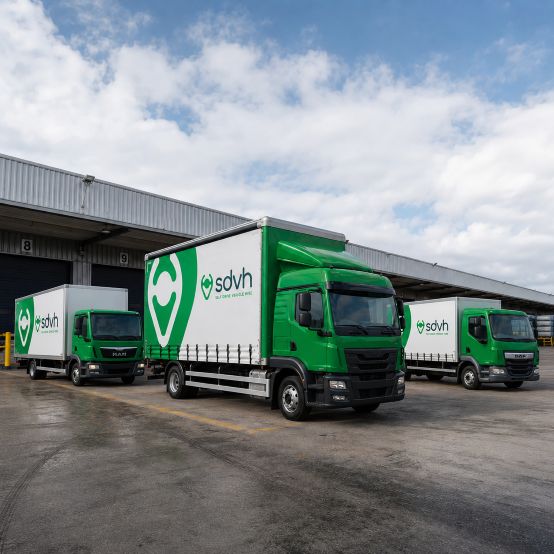
Confirm the load and tail-lift rating
Record the weight and footprint of the heaviest single item, not only the total consignment. Ask the booking team to confirm the proposed tail lift's platform dimensions and rated capacity for the actual vehicle.
Explain whether goods are on pallets, roll cages, trolleys or another base. The platform must accommodate the load and handling equipment without relying on an overhang or an estimated weight.
Plan the movement onto and off the platform
Say whether a pallet truck, trolley or manual team will move the item. The ground at both addresses needs enough level, stable working space for the vehicle, platform, load and people.
A tail lift does not move goods through a building or over steps by itself. Identify kerbs, slopes, gates, door widths and the route between the vehicle and final room.
Keep loading and load security separate
Lifting the load onto the vehicle is only one stage. DVSA and HSE guidance should be followed for safe loading, restraint during the journey and unloading.
Ask what restraint points and equipment are supplied, who is responsible for loading and how the consignment will be stabilised. Stop and clarify any uncertainty before the vehicle moves.
Give the complete site and timing details
Provide the exact collection and delivery entrances, access hours, loading-bay arrangements, vehicle restrictions and contact at each stop. Include any multi-drop order.
The booking team must confirm the actual vehicle, tail lift, driver requirements, mileage, total price, deposit, excess and return conditions. Availability should not be assumed from the guide or an example image.
Hampshire examples to apply to this guide
Andover: Use the guide's vehicle comparison for the real route, including any onward journey towards Upper Clatford and Picket Piece, rather than choosing from the category name alone.
Basingstoke: The council marks Castons car park, RG21 7NP, as suitable for oversized vehicles such as large transit-type vans and separately says oversized vehicles may need more than one marked bay. Check current signs, charges and the dimensions of the supplied vehicle before entering. Use the guide's vehicle comparison for the real route, including any onward journey towards Old Basing and Sherborne St John, rather than choosing from the category name alone.
Eastleigh: The Leigh Road store lists customer parking for moving in, moving out and visiting a unit. Treat that as a planning prompt and confirm whether the specific bay and approach suit the offered van at the intended time. Eastleigh Town Council explains that Hampshire County Council controls on-street parking enforcement, while Eastleigh Borough Council-owned car parks are excluded from that handover. For a move or trade collection, identify whether the proposed stop is on-street or in a council car park before checking the current loading and parking rules. Use the guide's vehicle comparison for the real route, including any onward journey towards Bishopstoke and Chandler's Ford, rather than choosing from the category name alone.
Fareham: Use the guide's vehicle comparison for the real route, including any onward journey towards Titchfield and Portchester, rather than choosing from the category name alone.
Portsmouth: Use the guide's vehicle comparison for the real route, including any onward journey towards Southsea and Gosport, rather than choosing from the category name alone.
Southampton: For visiting-supporter match days, Southampton FC says free Melbourne Street parking is for official supporters' coaches, private coaches or minibuses. Away coaches and minibuses must book through the page contact, and there is no general-admission parking on site. Check the fixture guidance before travel. SeaCity Museum advises coach and minibus drivers to set groups down before parking. It lists West Park Road (SO15 1FZ), Mayflower Park (SO14 2AG), Palmerston Road (SO14 1NH) and Herbert Walker Avenue (SO15 1HJ) for eight or more seats, and Amoy Street (SO15 2DR) for 'eight seats or less'. Use the guide's vehicle comparison for the real route, including any onward journey towards West End and Hythe, rather than choosing from the category name alone.
How to use this guide before calling
Use this tail-lift truck hire planning guide as a practical filter before you call. It should help you narrow the vehicle type, but the final booking still needs an availability check, driver check and terms check.
Write down the route, hire date, passenger count, luggage or load size, preferred transmission and delivery or collection address. Those details matter more than a broad label such as van hire, especially when the vehicle has to fit a specific job.
When to compare another vehicle category
If the trip changes, compare the guide topic with the wider van hire, truck hire services. A customer asking about a car body style may really need extra luggage space, while a customer asking about a small van may actually need a longer load bay or tail-lift option.
The safest booking conversation starts with the job, not the vehicle name. A light family journey, a station pickup, a student move, a trade delivery and an event run can all point to different vehicles even when the first search term sounds similar.
Local availability and route checks
Local hire areas are useful once you know where the vehicle is needed. They add nearby places, roads, stations and related service links, which helps the booking team understand the real journey.
For delivery and collection, give the full address and any restrictions such as parking, loading bays, timed access, height limits, gated entries or event traffic. Those details can affect whether the requested vehicle is practical.
Phone checklist for the booking team
Before calling, check who will drive, what licence they hold, whether an automatic is required, whether the journey needs European cover, whether one-way hire is being requested and whether company own insurance may apply.
For vans and trucks, add payload, loading method, tail-lift needs and site access. For cars and minibuses, add passenger count, luggage, child seats, pickup points and any long-distance plans. The clearer the request, the less generic the quote needs to be.
What not to assume from a vehicle name
Vehicle labels are helpful starting points, but they do not guarantee exact dimensions, equipment, transmission, seating, load space or model. Two vehicles with similar names can still differ in boot shape, roof height, payload, doors or licence requirements.
That is why the guide should lead into a phone check rather than a one-click promise. The booking team can confirm what is available for the chosen date and whether the vehicle still fits the actual route, driver and load.
Official sources and review date
Reviewed 2026-07-27. Check the linked operator or authority before travel because access and transport information can change.